
The slips I have had to take to a steering committee were almost never the ones I saw coming. They were surprises: sometimes an unknown unknown, more often a known risk that turned into an issue.
One I remember well. On a hardware development program, we had assumed all along that there would be no failure loop in the development cycle. Then a major failure came along that required a redesign and a retest of the device. That meant a lot more work, and more expensive work, including procuring additional components, and it put the budget well above what we had anticipated. The steering committee had to review both the program budget and the timeline, so that resources could be reshuffled across the business unit and everyone's expectations could be reset.
The slide for that kind of meeting is the hardest one a project manager builds. Not because it is complicated, but because every instinct says to soften it: shrink the bar, move the label, call it "at risk" for one more month. This post is the version that holds up in the room.
Tell the sponsor before the slide exists
A steering committee can absorb a slip. What it does not forgive is learning about it from slide 7. Practitioners interviewed by PMI's PM Network make the same point about escalation: flag the problem early, keep it factual and arrive with a recommended resolution, so the meeting is spent deciding, not reacting.
The first question in the room is almost always "when did you know?" Have a dated answer.
How I do it depends on the circumstance, how severe the problem is and the precedent on that program. But the rule holds: heading into a monthly leadership review, I tell the leadership about any large surprise beforehand, so the meeting is not the first time they hear it. I do that one-on-one, person by person. If a one-on-one isn't possible, I send an email. At the very minimum that gives each leader a heads-up and a chance to ask questions before they are in the room.
One slide, five things, in this order
The slip gets one slide. If it needs three, the story is not clear yet. In order:
- The headline, as a sentence with both dates. "Design verification complete moves from Mar 14, 2027 to Apr 25, 2027 (+6 weeks)." Not "Schedule: Yellow".
- The cause, in one line. What happened, not who did it.
- What it moves downstream. Which gate, submission or launch date follows it, and which ones don't.
- The options. Two or three, each with its cost.
- The ask. The decision you need from the people in the room, today.
Items 1 and 3 are a timeline. Items 2, 4 and 5 are text beside it. Everything else goes in backup.
Show the old date next to the new one
A timeline that only shows current dates cannot show a slip. The honest picture keeps the approved plan visible: a faint bar where the work was supposed to be, the solid bar where it is now, and the difference written out as a number.
That requires a baseline, saved on the day the plan was approved and left alone. Microsoft Project, for example, lets you save up to 11 baselines in one plan, each stamped with the date it was saved. The feature is rarely the problem. The discipline is.
This is the view we built into PMO Pilot: save a baseline when the plan is approved, and after that each update draws the slipped item against it with a label like "+42d". The Plan vs Actual look puts one item per row so the committee can read down the slip column.
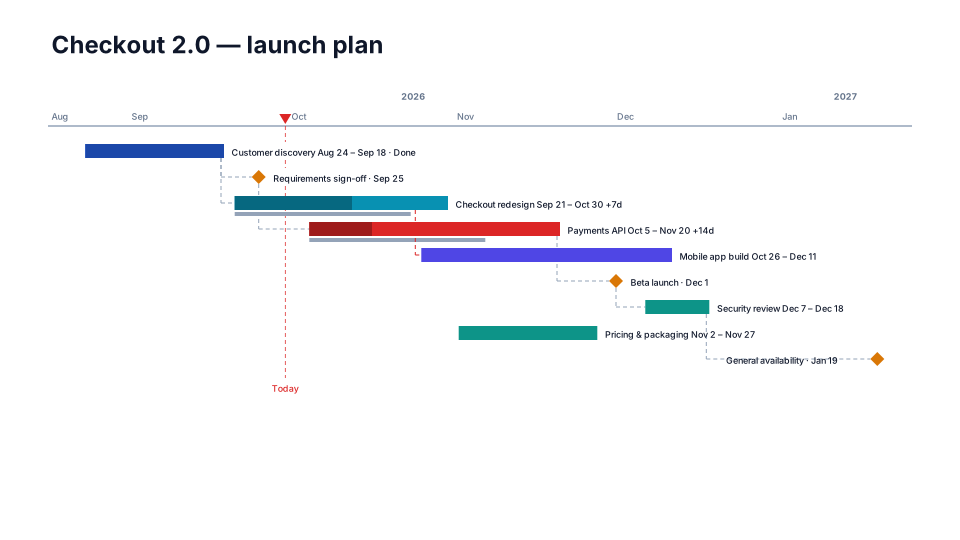
Two details matter more than the styling:
- Show only what moved, plus the critical path. Forty bars with one slip hidden among them is another way of softening the news. If the slipped item is on the chain that drives the finish date, outline that chain. If it isn't, say so, because that is the good news.
- Keep gates as diamonds with full dates. "Apr 25, 2027", not "late April". An executive will repeat your date in another meeting.
Say what the slip costs
The redesign I described was closer to a three-month slip. Three months sounds like a schedule number, but it is a money number. Take the units you expected to sell, multiply by 90 days, and you get the revenue the business is potentially missing. On a project that is critical to the business unit, every week counts, and the committee should see the slip in those terms as well as in days.
Don't rebaseline to make it go away
The quiet way to erase a slip is to reset the baseline so the new date becomes the plan. The history goes with it.
A baseline should change only when the people who approved the original plan approve a new one, and the old one should stay on file. Then "we are six weeks late against the plan approved in January, and on time against the replan approved in June" is a sentence you can say out loud.
There is no one way to deliver it
This is where I part ways with most of the advice on the subject. There usually isn't a single approach that works with everybody. People have different personalities, characters and preferences. A high-level standard for how to report against a metric is good to have. How a given piece of news will land with a given person is a different matter, and it varies from one leader to the next.
So I tailor how much I share and how I share it. That matters most when I am asking a leader for something. The request is where the tailoring pays off.
Bring options, not an apology
A slip presented alone invites a search for who caused it. A slip presented with choices gives the committee a job to do. In a PM Network roundup on delivering bad news, the pattern that worked was the same across very different projects: explain the issue and its cause, lay out the options and recommend one.
For a schedule slip the options usually come from a short list:
| Option | What it costs |
|---|---|
| Accept the new date | The downstream dates move with it |
| Add people or money to recover time | Budget, and often less time than hoped |
| Run later work in parallel | Risk of rework if the early work changes |
| Cut or defer scope | Something the committee was promised |
Put a date on each option, not an adjective. "Recovers 3 of the 6 weeks" can be decided on. "Mitigates the delay" cannot.
Write down the questions first
What I would do differently, and what I now try to do every time: anticipate the questions in advance and actually think them through. It is human nature to wing a meeting. Set aside an hour instead, list every question you expect, and at the very minimum write down your answers. The writing is what clears your head and tells you whether you are truly ready. It has proven helpful in my monthly leadership meetings too, not only on the bad days.
Tomorrow morning
Open the timeline slide from your last review and look for the approved dates. If the slide only shows where things are now, find the version of the plan that was signed off, save it as the baseline, and put last month's dates back on the slide as faint bars. You will know within five minutes whether you have a slip to present, and you will have most of the slide.